December 12, 2025
From Binders to Browsers: How Technology Transformed NECC’s Curriculum
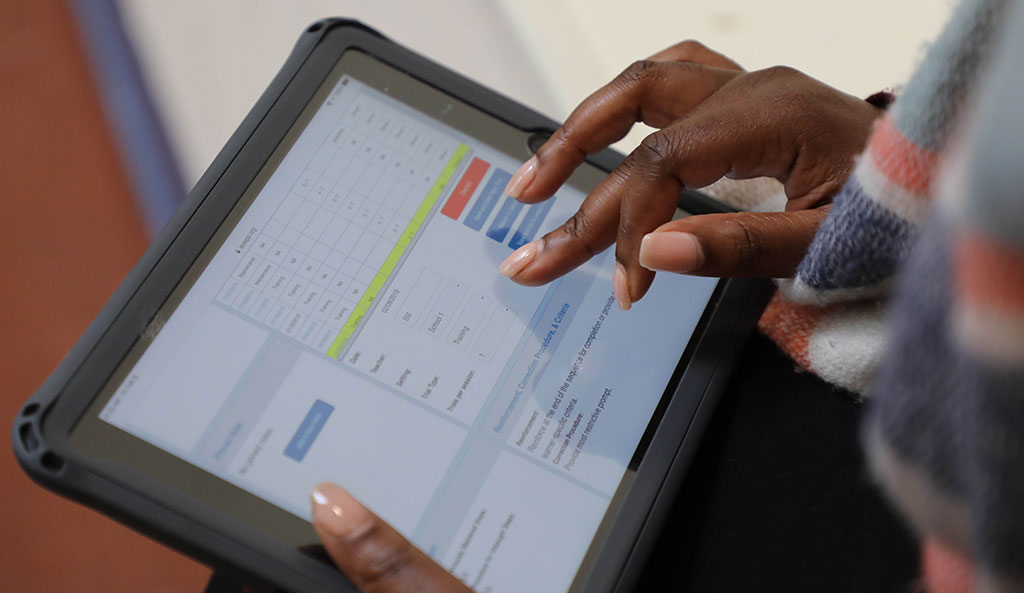
When The New England Center for Children opened 50 years ago, its mission was clear: deliver the highest-quality, evidence-based education to children with autism. Long before digital tools, that work relied on paper, pencils, and thick binders of handwritten curriculum.
“We had this big curriculum book,” recalled Bill Holcomb, PhD, BCBA-D, LABA. “If you needed to teach a skill, you turned to a page. That’s how NECC’s curriculum began.”
The binder worked — but it was cumbersome and difficult to update. As NECC began developing a digital student database, leaders saw an opportunity to digitize the curriculum as well. Kathy Foster, former COO and current board member, helped shape what would become the Autism Curriculum Encyclopedia® (ACE®).
From the start, ACE® was never meant to be just software. It was designed to share NECC’s decades of clinical expertise with educators everywhere. “Vinnie always wanted to provide a curriculum for everybody,” said Becky MacDonald, PhD, BCBA-D, LABA. “He believed in what NECC could offer beyond its walls.”
Working with the late Renee Mansfield, Dr. MacDonald helped build a standardized curriculum anchored by a robust digital data system. A major breakthrough came with the NECC Core Skills Assessment (NECC-CSA), a comprehensive tool measuring essential skills across the lifespan. To ensure its relevance, the team gathered feedback from educators, parents, and professionals nationwide.
In 2014, NECC researchers published the NECC-CSA, establishing the scientific foundation for ACE®. For years, the platform was used exclusively at NECC, until leaders began exploring how it could support students elsewhere.
“Vinnie always said the building could only hold so many kids,” said Frank Ciccone, MA, MS, BCBA, LABA, now director of ACE® distribution and services. “ACE® was a way to help far more children beyond the Center.”
To make that vision possible, NECC launched its first major fundraising campaign, ensuring the platform remained accessible and affordable. Today, more than 14,000 learners worldwide use ACE® in schools, hospitals, and universities — including 16 higher education programs training future behavior analysts.
As educational technology rapidly evolves, ACE® remains grounded in NECC’s nonprofit mission and clinical roots. “You can’t replace skilled staff with machines,” Foster said.
“What makes ACE® different,” Ciccone added, “is that it’s built by people who use it every day — from assessment to curriculum to data collection. It’s practical, integrated, and rooted in real classrooms in real time.”
ACE® Timeline
- 1998: NECC receives The Doug Flutie, Jr. Foundation for Autism, Inc. grant for the development
- of the ACE®.
- 2003: The first lesson is published to the ACE®.
- 2006: The ACE® software expands beyond NECC classrooms and moves into public schools in New England.
- 2009: The ACE® software reaches 1,000 lessons spanning three lesson formats (Discrete Trial, Task Analysis, and Incidental Teaching); The ACE® software makes its way to New York City, which launches a pilot program to integrate the ACE® software into public school classrooms.
- 2011: The ACE® is covered by U.S. Patent number 7,974,569 B2.
- 2015: NECC receives the New England Innovation Award from the Small Business Association of New England (SBANE). The award recognizes the groundbreaking work NECC has completed on the ACE® software.
- 2021: ACE® surpasses 10,000 learners worldwide.
This article originally appeared in the 50th Anniversary edition of Insight.