December 19, 2025
How Teaching and Learning Have Transformed NECC
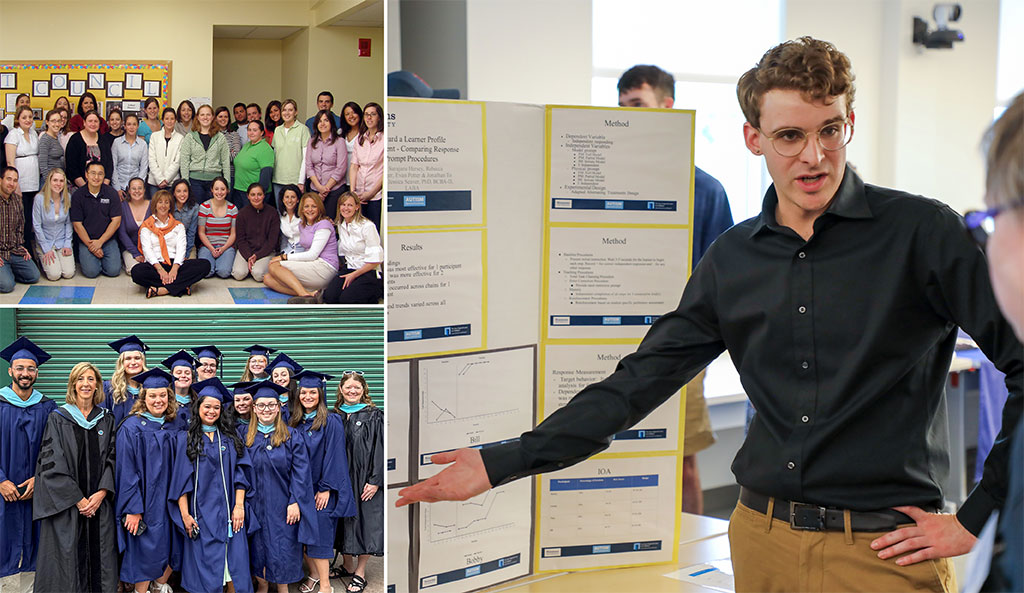
Inside the graduate partnerships that shaped five decades of growth — and the future of the field.
This spring, more than 50 NECC staff members — both in the U.S. and the UAE — celebrated earning their master’s or doctoral degrees through NECC’s partnerships with Simmons University and Western New England University (WNEU). With their achievements, they joined more than 1,900 professionals who have completed advanced degrees through NECC’s graduate program partnerships.
For 50 years, NECC has been committed not only to serving students with autism but to training the next generation of educators and behavior analysts. That commitment has reshaped the organization and helped define the entire field of applied behavior analysis.
From Vouchers to Vision
NECC’s legacy of graduate education dates back to the late 1970s, when three ERI staff members used educational vouchers from Northeastern University to pursue degrees in special education and speech-language pathology.
“We would work all day, then drive up to Northeastern three nights a week to take classes,” recalled Kathy Foster, who spent 42 years at NECC. “That was the beginning of people working and getting their education.”
That small connection laid the foundation for something far bigger.
During the 1980s and early 1990s, Northeastern’s influence grew at NECC, culminating in a formal partnership in 1992 with the master’s in applied behavior analysis (MABA) program. Dan Gould, PhD, BCBA-D — a Northeastern graduate and former Shriver Center staff member — was instrumental in establishing the partnership. His wife, Karen, led Northeastern’s program at the time.
“It was a very applied and very unique program,” said Bill Holcomb, PhD, BCBA-D, LABA. By the time he joined NECC in 1996, the MABA program had become a pipeline for NECC staffing, with classes held partly at NECC itself.
The Simmons Revolution
Also in 1996, NECC launched a partnership with Simmons University to offer an on-site master’s degree in education and licensure in severe disabilities. The effect was immediate and profound.
“The move to Simmons created almost a revolution in the organization,” said founder and former CEO Vinnie Strully. “It was a huge recruiting tool for years, and it still is.”
The model was simple but powerful: NECC hired bright, motivated individuals, and Simmons provided the training necessary for them to become highly skilled teachers. In return, NECC retained staff for the duration of the program.
For 33 years, Chris Evans, MEd, has directed the Simmons program, helping shape a curriculum that blends teaching and behavior analysis. “What really sells our students is the combination of the NECC experience and the Simmons education,” Evans said. “Together, they are incredibly powerful in any specialized placement.”
As NECC expanded globally, the Simmons program followed. At first, U.S.-based staff working in Abu Dhabi completed their practica remotely. But under the nudging of Dr. Dan Gould and local leadership, the program evolved.
“About four years ago, we created a master’s curriculum for locally hired staff,” Evans said. “It didn’t require licensure but maintained our academic rigor.”
For Pam Olsen, PhD, BCBA, executive director of MRC-NECC, the impact has been transformative. “It provided equity for all employees,” she said. “Our locally hired staff now have the same opportunities — and the quality of teaching has improved dramatically. Things we never thought possible four years ago, like circle time and group instruction, are now happening every day.”
Clinical Training and the Western New England Partnership
While Simmons strengthened teacher preparation, NECC recognized the need for deeper clinical training for future behavior analysts. That led to a partnership with Western New England University (WNEU) beginning in 2008, offering both master’s and doctoral programs in ABA.
“There are very few graduate programs that can integrate expert coursework with the level of clinical experience NECC offers,” said Bill Ahearn, PhD, BCBA-D, LABA, director of Research. “We have a model, and that has allowed us to produce a large number of excellent behavior analysts.”
This partnership created a thriving academic community where staff learned in the same environment where they practiced and conducted research.
“You’re learning on the job, in the same place you’re taking classes, surrounded by your mentors,” said June Kivi, MSEd, BCBA, LABA. “It’s a comprehensive and supportive experience. You don’t get that anywhere else.”
Strully described his vision for NECC as similar to a teaching hospital — a place where people come to learn, train, teach, and then carry their expertise into the world.
“I’ve said this every year for 50 years: give us three years, and we’ll give you an education and a career,” he shared. “We’ve sent thousands of former staff into the field, trained and running their own programs.”
Preparing the Future of the Field
Many of those graduates now lead programs around the world, including in Brazil, Ghana, and Iceland. For President and CEO Jessica Sassi, PhD, BCBA-D, LABA, this is central to NECC’s mission.
“To continually evolve, our staff need to evolve,” she said. “That’s where our partnerships with Simmons and WNEU come in. We can grow our own behavior analysts and special educators, and we can be confident these programs give them a robust education tailored to our population and setting.”
“At the end of the day,” she added, “we have clinicians and educators who are prepared to do this important work.”
This article originally appeared in the 50th Anniversary edition of Insight.