November 21, 2025
The Evolution of Research at NECC: A Legacy That Shapes the Present and Future
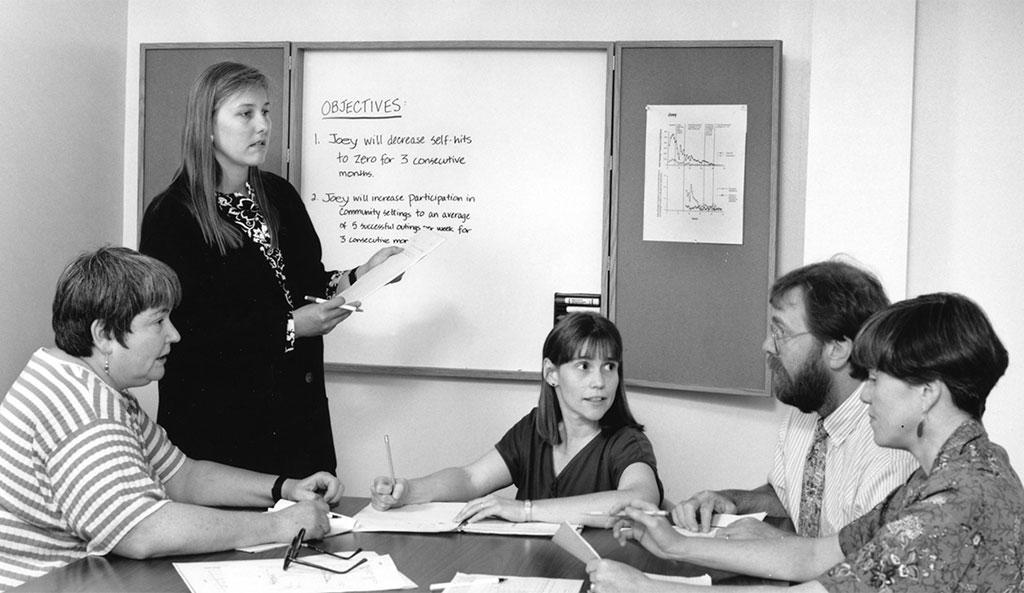
How a culture of curiosity, mentorship, and science built one of the strongest research programs in autism education.
In NECC’s earliest days, research wasn’t a department — it was survival. With limited published guidance in applied behavior analysis (ABA), staff often learned procedures the night before and tested them the next day.
“There was very little literature in the field,” recalled founder and former CEO Vinnie Strully. “I remember reading instructions from an article in the Journal of Applied Behavior Analysis while someone was running a session. We would read it like it was a cookbook because we didn’t have anything else.”
This hunger for knowledge defined NECC’s research culture long before it became formalized. Staff read journal articles in the evenings and applied its principles in real time, laying the foundation for the organization’s scientific identity.
Building the Research Program: The Early Architects
In 1978, NECC hired its first research consultant, Paul Touchette, PhD, a leading voice in the field. For years, Dr. Touchette helped the team integrate ABA systematically and effectively. But as the number and needs of students grew, it became clear NECC needed full-time clinical directors deeply engaged in research and practice.
In 1983, Becky MacDonald, PhD, BCBA-D, LABA, joined ERI Taunton and was immediately inspired. “I was blown away,” she recalled, especially by NECC’s early work in social skills instruction. “I knew I had to be here because I could learn.”
One of NECC’s first formal research contributions came from Drs. Touchette and MacDonald, together with Sue Langer, MS, BCBA, LABA — the development of the scatter plot, a now widely used visual tool for identifying patterns in challenging behavior. “Our core strength has always been stimulus acquisition and skill acquisition — teaching how to better teach,” said Strully.
Throughout the 1980s and 1990s, NECC attracted some of the most influential minds in ABA, including Murray Sidman, PhD; Gina Green, PhD, BCBA-D; Richard Foxx, PhD, BCBA-D; and Brian Iwata, PhD, BCBA-D. Their mentorship shaped NECC’s research questions and strengthened its scientific rigor.
A Culture of Mentorship and Momentum
As the research community grew, staff were encouraged to design and publish their own projects — often before even completing graduate school. Nicole Ciotti, now executive director of ACE®, recalls presenting at conferences early in her career. “I never imagined I’d be a published author,” she said. “That’s primarily because of encouragement from Becky and Bill Ahearn.”
When Bill Ahearn, PhD, BCBA-D, LABA, became director of research in 1996, NECC had published around 25 studies. Today, the numbers are extraordinary:
- 342 publications
- 2,737 conference presentations
- research shared in 22 countries
NECC’s presence is especially strong at major gatherings like Massachusetts Professionals in Behavior Analysis (BABAT) and Association for Behavior Analysis International (ABAI), where large contingents present work every year.
“Research helps us be better clinicians, better educators, better supporters of families,” said Dr. Ahearn. “I feel privileged to be part of a group so invested in becoming better.”
NECC’s research has shaped the field in profound ways, including:
- Cam Johnson’s work on instructional design
- Rick Graff’s influential preference and reinforcer assessments
- Becky MacDonald’s methods for teaching play skills
- Bill Ahearn’s research on response interruption and redirection
- Eileen Roscoe’s contributions to functional analysis and treatment
Perhaps most impactful is the collaborative work that produced the Early Skills Assessment Tool (ESAT) and the Core Skills Assessment — the backbone of the ACE® ABA Software System.
Research That Shapes Practice and Policy
What distinguishes NECC is not just the volume of research — but how deeply it is woven into practice.
“Baked into NECC’s heritage is a commitment to research informing our work,” said President and CEO Jessica Sassi, PhD, BCBA-D, LABA. “We conduct research for the entire community. We publish and disseminate so everyone grows. And then we apply what we learn to improve our curriculum and clinical practice.”
This integration is what makes NECC’s model so effective, she explained: “A legacy of researchers, clinical directors, and educators has shaped who we are. That’s why our curriculum works.”
Cammarie Johnson, PhD, BCBA-D, LABA, director of education services, emphasized the same point. “The research program is how we move. We’ve never been stagnant — we’re always trying to improve for the sake of our students.”
This article originally appeared in the 50th Anniversary edition of Insight.